Gridline Arcade
A live two-player arcade for Connect Four, Ultimate Tic-Tac-Toe, and strategy variants.
Open the arcade ↗PERSONAL PORTFOLIO / N1 AI SCHOOL
From the a priori to the a posteriori.
From logic to experiment.
I used to look for answers within the system. Now I also want to see what happens when I put it to the test.
Explore my work01 / PROJECTS
A live two-player arcade for Connect Four, Ultimate Tic-Tac-Toe, and strategy variants.
Open the arcade ↗An interactive modal logic tool. Build possible-world models, change which worlds are accessible, and use countermodels to test validity across logical systems.
Open Logic Lab ↗An AI agent strategy tournament built by Paideia. Players write prompts for opposing roles, run matches, and review battle reports to understand strategy and adjudication.
Live product ↗ · Source on GitHub ↗I designed scenario-based multiple-choice questions, worked on the Prompt Builder and the first-match experience, and contributed to frontend design and debugging.
I interviewed users, designed a human testing system, and participated in review syncs and chain-of-thought reviews. I also designed and ran benchmarks to test AI judge bias and how sensitive rulings were to changes in the inputs.
02 / WRITING & FOUNDATIONS
My interests include philosophy of mind, language, and mathematics. I also serve on the North China organizing committee of the Secondary School Philosophy Conference. Below are three Foundations preprints and one of my competition essays.
Philosophy of mind
Examines whether first-person experience can be treated as a variable in third-person scientific explanations.
Read preprint ↗Philosophy of language & science
Uses the heap paradox to distinguish our tolerance for small changes from the question of what makes “heap” true.
Read preprint ↗Logic & philosophy of mathematics
Distinguishes what the theorems establish from the extra premises needed to draw conclusions about minds, mathematics, or knowledge.
Read preprint ↗2026 John Locke Essay Competition · Philosophy Commendation
My essay distinguishes consolation through an answer from the relief that comes when we question why an answer seemed necessary.
Read essay (PDF) ↗I developed the journal’s original proposal and defined its scope around foundational questions in logic, mathematics, science, and AI. As Editor-in-Chief, I helped shape an editorial process built around feedback and revision, including an optional AI collaboration appendix where authors can explain how they used AI and which judgments they made themselves.
INDEPENDENT STUDENT PREPRINT JOURNAL
The first issue brings together five student preprints.
Read the journal ↗ · Editorial team ↗03 / NOW
I used to want an explanation for why a method should work before trying it. While training mini-GPT, I watched validation loss fall even as the model still contradicted itself in its continuations. I wondered about the data first. What was I measuring, and what did I expect that number to tell me?
After short-answer fine-tuning, the model got some copying and extraction tasks right. It also started all eight yes/no reasoning answers with “Yes” and missed all four whose correct answer was “No.” I hadn’t anticipated that failure. Now I’m more willing to test an intuition with a small experiment, then let the result change the question I ask and the explanation I give.
At N1, I started by writing a BPE tokenizer and running controlled comparisons on TinyStories. I went on to pretrain a 408M-parameter model on 6B tokens of FineWeb-Edu and compare fine-tuning recipes on a fixed set of prompts.
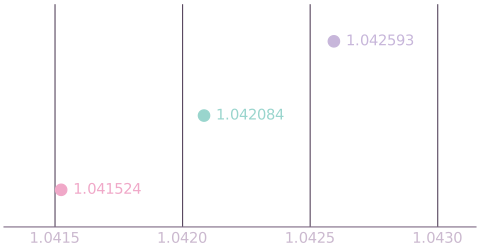
I compared fixed frequencies and learnable rotary position embeddings on TinyStories using a model with about 14.56M parameters. The confirmation runs used three random seeds per method.
| Method | Mean NLL |
|---|---|
| Fixed RoPE | 1.042593 |
| Shared learnable log frequencies | 1.042084 |
| Randomly initialized learnable frequencies per layer | 1.041524 |
The per-layer variant averaged about 0.10% lower NLL than the fixed baseline and won on two of three seeds. The difference is small and comes from one dataset and model size.
In an exploratory four-choice, single-fact retrieval task with a 512-token gap, the random per-layer variant averaged 86.98% accuracy versus 55.73% for fixed RoPE. At a 2,048-token gap, all variants were near chance.
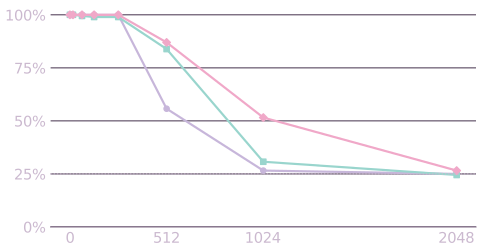
Fixed RoPEShared learnable log frequenciesRandom per-layer
04 / RECOGNITION
05 / EDUCATION
06 / CONTACT